Showing posts sorted by relevance for query solid. Sort by date Show all posts

Baltimore Oriole

 The rich, whistling song of the Baltimore Oriole, echoing from treetops near homes and parks, is a sweet herald of spring in eastern North America. Look way up to find these singers: the male’s brilliant orange plumage blazes from high branches like a torch. Nearby, you might spot the female weaving her remarkable hanging nest from slender fibers. Fond of fruit and nectar as well as insects, Baltimore Orioles are easily lured to backyard feeders.
 Keys to identification Help
Blackbirdlike
Blackbirdlike
Typical Voice

Size & Shape
Smaller and more slender than an American Robin, Baltimore Orioles are medium-sized, sturdy-bodied songbirds with thick necks and long legs. Look for their long, thick-based, pointed bills, a hallmark of the blackbird family they belong to.
 Color Pattern
Adult males are flame-orange and black, with a solid-black head and one white bar on their black wings. Females and immature males are yellow-orange on the breast, grayish on the head and back, with two bold white wing bars.
 Behavior
Baltimore Orioles are more often heard than seen as they feed high in trees, searching leaves and small branches for insects, flowers, and fruit. You may also spot them lower down, plucking fruit from vines and bushes or sipping from hummingbird feeders. Watch for the male’s slow, fluttering flights between tree tops and listen for their characteristic wink or chatter calls.
 Habitat
Look for Baltimore Orioles high in leafy deciduous trees, but not in deep forests: they’re found in open woodland, forest edge, orchards, and stands of trees along rivers, in parks, and in backyards.
 Baltimore Oriole
Adult male

Slender body shape with sharp, pointed billBright orange underparts with black headBlack and white wings with orange shoulders Black tail tipped with orangeCommon spring/summer resident in eastern and central U.S.
 Baltimore Oriole
Adult male

Bright orange with black headBold white markings on black wingsSharp silver/black bill

Baltimore Oriole
Immature male

Slender body shape and long tailSharp, pointed billBright orange underneathDusky gray head and back
 Similar Species
The distinctive shape and bright colors of orioles help set them apart from most other species. Orchard Orioles are noticeably smaller than Baltimore Orioles. Male Orchard Orioles are rich chestnut, never bright orange, and female Orchard never show any orange tones. Immature male Orchard Orioles have a solid black throat (unlike the partial hood of Baltimore) and yellowish-green underparts. Bullock’s Oriole occurs mostly west of the Baltimore Oriole's range, but the two species occasionally hybridize in the Great Plains. Male Bullock’s Orioles have orange faces, a black line through the eye, and a larger white patch in the wings. Females and immature males have much grayer underparts than Baltimore Orioles. Some people occasionally mistake American Robins for Baltimore Orioles, but robins are thrushes with shorter bills, rounder heads, solid-brown backs, and a more subdued shade of orange on the breast.
 Backyard Tips

Baltimore Orioles seek out ripe fruit. Cut oranges in half and hang them from trees to invite orioles into your yard. Special oriole feeders filled with sugar water supplement the flower nectar that Baltimore Orioles gather. You can even put out small amounts of jelly to attract these nectar-eaters (just don't put out so much that it risks soiling their feathers). Planting bright fruits and nectar-bearing flowers, such as raspberries, crab apples, and trumpet vines, can attract Baltimore Orioles year after year.
 Find This Bird

Aim your eyes high when looking for Baltimore Orioles. They’re most often seen perched at the tops of trees or flitting through the upper foliage in search of insects. Listen for their distinctive chatter, which is unlike the call of any other bird where orioles occur. Noisy nestlings may alert you to a nest site high off the ground.


Regional Differences
In central North America—including Kansas, Nebraska, Saskatchewan, and Alberta—the Baltimore Oriole’s range overlaps with its close relative the Bullock’s Oriole, and the two species breed with each other. Their hybrid offspring—brighter orange than a typical Bullock’s, but duller than a typical Baltimore—can confuse bird watchers.

Fun Gifts for the Nature Lovers

Holiday Bird Food Essentials

Solid Seed and Nut Ornament 
Give your backyard friends a gift they'll really enjoy. Extra-large wild bird seed ornaments are solid, compact balls of mixed birdseed and pecans. They can be hung on outdoor trees, porch hooks, or shrubs as a treat for clinging birds. Features red raffia bow and jute hanging loop. Each ball measures approximately 4" dia. This is a perfect gift to have on hand to pass out to teachers, hostesses, unexpected guests and other friends and family.
 .
Giant Bird Seed Pinecone
Giant Pinecones coated with sunflower seed without the shell and tied with twine so you can hang them over a branch. A fun way to decorate an outdoor tree in your own yard, these pinecones makes charming, nature-inspired gifts for bird lovers. 

Buttons the Snowman Seed Cylinder
Available for a limited time only, our Snowman Seed Cylinder is a seasonal mix of safflower, sunflower chips, peanuts, cherries, blueberries and papaya to attract a variety of birds. Simply slide the Snowman Seed Cylinder onto our WBU Seed Cylinder Feeders or WBU Dinner Bell™ feeder and enjoy the feathered holiday visitors. This is an adorable and unforgettable treat birds really love! 
WBU Supreme Fare Seed Wreath
The WBU Supreme Fare Seed Wreath does double duty during the winter season. Not only is it a dining delight for birds, but it also adds festive cheer to any yard. This wreath is full of seasonally-appropriate ingredients including sunflower seeds, peanuts and pecans.

It makes the perfect gift for friends that love nature but might not need another feeder. The wreath is 100% edible. Birds will eat this treat until it disappears completely.

Each wreath comes in a clear wrapped gift box and includes a red hanging ribbon and seed net. 

Related Articles: 
- Let's all share Nature's bounty http://bit.ly/tgPkrv 
- Edible ornaments for the birds http://bit.ly/tXDnSB
- Decorate a Tree for Your Birds http://bit.ly/t3QtGV
- Filling Up on Fatty Foods http://bit.ly/tUElnw

Product Highlight: Solid Seed Cylinders

The Seed Cylinder feeders are popular with people who have been bird feeding a long time and for beginners. It is one of the easiest feeders to maintain and attracts a wide variety of birds.

For people that aren't able to get out to fill feeders often during our harsh Michigan winters this feeder is ideal. Depending on bird activity in your yard, a 2lb cylinder can last up to a month and a 4.5lb cylinder can last a couple months.

Our popular Supreme Fare Solid Seed Cylinders are packed pecans, sunflower chips, peanuts, safflower, black oil sunflower and the Cranberry Fare also has cranberries - everything you need to get lots of birds to visit your backyard with very little mess. And it's convenient, too. We have several feeders that hold the cylinders, and create perching areas for birds like the Northern Cardinal.

If you don't have a baffled Wild Birds Unlimited Advanced Pole System and worry about the squirrels, the Safflower cylinder will keep most squirrels and blackbirds away. Seed cylinders are a fun new way to feed the birds that is both easy and affordable.

Related Articles:
- Exciting New Bird Food at Wild Birds Unlimited Stores http://goo.gl/LpVQne
- Why don't chickadees stay to eat at the feeder? http://bit.ly/AkKThH
- What to feed birds in the winter http://bit.ly/rCdQqM
- Holiday gift ideas for nature lovers: http://bit.ly/v8L2va
- Feeding the birds will not make them dependent. http://goo.gl/dqYQu

How to feed birds with less mess

Like feeding the birds but don't want a mess on the ground? At Wild Birds Unlimited (WBU) I recommend the following combinations of food, feeders and accessories so you can enjoy feeding your birds and have a tidy backyard, too.
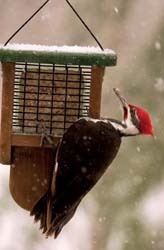
Ranchette Retreat bird feeder is a fully functioning bird buffet that holds over 10 pounds of WBU No-Mess birdseed and two WBU suet cakes. Our unique No-Mess Blend features seeds that have had their shells removed so only the meat of the seed is left. No shells left on the ground and nothing will grow under the feeder. You will attract all the seed and suet eating bird species such as cardinals, finches, jays, chickadees, woodpeckers and more.

To protect the seed, the Ranchette Retreat has an extra large green roof that overhangs the extra large tray area. It also has a mesh screen bottom with a built in seed diverter to keep seed moving through the feeder smoothly and to prevent moldy seed.
This feeder is good for a compact, yet versatile tidy feeding station. Fill with the WBU No-Mess birdseed blend so there are no shells left on the ground.

As a bonus the Wild Birds Unlimited's Quick-Clean feeders have removable bases that make cleaning a breeze. They’re also easy to fill and hang. Simply add our Weather Guard dome to your feeder to help protect the seed and birds from inclement weather. The Seed Tray prevents seed from falling to the ground and serves as an additional feeding area.

3. The WBU Seed Cylinder feeder 
Cylinder feeders are versatile feeders that can provide a tidy dining experience. The Seed Cylinder feeders are popular with people who have been bird feeding a long time and for beginners. It is one of the easiest feeders to maintain and attracts a wide variety of birds.
Our popular Cranberry Fare Solid Seed Cylinders are packed pecans, sunflower chips, peanuts, safflower, black oil sunflower and cranberries - everything you need to get lots of birds to visit your backyard with very little mess.

If you are worried about squirrels and don't have a baffled Wild Birds Unlimited Advanced Pole System, our Safflower cylinder will keep squirrels and blackbirds away.

Related Articles:

There are two oriole species found in Michigan

I was telling my neighbor about my struggle to attract orioles. He says he has several species of orioles visiting his Wild Birds Unlimited feeders. How many species are there in Michigan? ~ St. Johns, MI

There are 9 oriole species in North America. The Baltimore Oriole and the Orchard Oriole are the 2 species that nest in Michigan as well as the Eastern half of the U.S. The Bullock's Oriole and the Scott's Oriole are found in the Western Regions. The Spot-breasted Oriole is found in Central Florida. And the Altamira Oriole, Audubon's Oriole, Hooded Oriole and the Streak-backed Oriole are mainly found in Mexico and some southwestern states.

The Baltimore Orioles have adapted well to human settlement and often feed at nectar/jelly/fruit/mealworm/suet feeders. The Orchard Oriole also may come to eat at our backyard feeders but are not as common. One studyfound they ate 91% insects and 9% plant materials during the breeding season.

The confusion on the number of species of orioles in Michigan may be because their physical description can vary depending on whether you see a breeding or non-breeding male, female, young, or 1st year oriole.

Adult Baltimore Oriole males have a bright orange body and a solid black hood and back. Their wings are black with white wing bars, and the tail is orange with black streaks. Adult females are paler than males and can range in color from yellow to orange with a brown tweed to blackish head, back and wings. Juveniles are yellowish-brown with dark brown wings that have a white wing bar. And immature Baltimore Orioles are variable. Typically they resemble the female until they grow their adult plumage after they are a year old.

Breeding Orchard Oriole males have dark orange or brick red bodies and a black hood, back and wings. The wings also have chestnut epaulets and a white wing bar and tips. In the fall the non-breeding male grows chestnut-tipped feathers which may obscure the black coloration.

Breeding Orchard Oriole females are bright greenish yellow below, olive-green above with brownish wings that have two narrow white wingbars. Non- breeding females are duller in color.

Juvenile Orchard Orioles of both sexes are similar in appearance to adult females, but they are browner above and more yellow below

Second year males are similar to adult females, but have a solid black bib and black between the eye and bill. How much black adult plumage varies considerably between individuals, with some males of this age having blacker feathering than others. 

Related Articles: 
- Facts on the Baltimore Oriole http://bit.ly/GzSTbi
- Where do orioles winter? http://bit.ly/GAeWv5
- Close-up of Baltimore Oriole http://bit.ly/GAf6T7
- When can I expect my orioles to arrive? http://goo.gl/OHrCc

Yellow-bibbed Lories


Yellow-bibbed Lory

Before the early 1990s, the yellow-bibbed lory (Lorius chlorocercus) was nearly unknown in U.S. aviculture and, even then, only a handful of the birds were imported from the Solomon Islands. In 1998, a captive breeding consortium, called the Solomon Island Parrot Consortium (SIPC), was formed and received permission from the government of the Solomon Islands and permits from USFWS to import 30 pairs of each of the six species of lories found in the Solomon Islands.

These 60 yellow-bibbed lories were the first species imported under this permit. From these original 60 birds, there are now enough birds that they are beginning to show up as pets from time to time. They were bred for the first time in United States in 1989, in the Seattle aviaries of Jan van Oosteen, who is considered the force behind obtaining this group of 30 pairs.

Yellow-bibbed lories, like the rest of the genus Lorius, are large (11 inches), stout birds with fairly long, wide tails. All of the Lorius species have green wings and mostly red body feathers and all have black-capped lories (except for the chattering lories and yellow-backed lories). As with nearly all lories, two eggs are laid in each clutch and incubation is about 26 days. Yellow-bibbed lory chicks hatch covered in dense white down and they have brown beaks.

As pets, whether here or in their native land, they are excellent, as are the others of their genus, which include the chattering and yellow-backed chattering lories and all of the black-capped lories, purple-bellied, white-naped and the purple-naped lories. The chattering and black-capped lories are the only species, besides the yellow-bibbed lory, that are likely to be encountered as pets. The others are either non-existent in the United States, or are far too rare and are, therefore, kept as breeders.

Diet Differences For Yellow-Bibbed Lories
Many lory species do quite well on a diet of nectar and some fruit, but this is not so with the yellow-bibbed lory. They should be fed about 25-percent solid food along with their nectar. By solid food, I refer to a variety of fruit (no citrus) and vegetables, maybe a bit of pound cake, a carrot or perhaps some cooked brown rice. Even a few sunflower seeds wouldn't hurt. 

They also must be provided with a supply of fresh water, even if the nectar takes care of their liquid intake. They love to bathe, but prefer rubbing around in wet foliage.

Yellow-Bibbed Lories Are Talented Talker
As with all of the Lorius, yellow-bibbed lories are loud, gregarious birds with a great ability to mimic all sorts of sounds, including the human voice. I believe that they the least vocal of the genus, though it can't be said that they are quiet. They are among the best talkers of all of the lories. 

They are also extremely intelligent birds, perhaps the smartest of the lories, and, as such, they need plenty of mental stimulation, lots of toys of various types, time out of the cage with the owner or a companion bird. Warning! If you're considering a companion bird, be aware that the larger lory species are very quick to injure or even kill another bird, so much caution should be exercised should you wish to attempt this. Certainly it can be done, but do it with care. It's actually quite easy to introduce two birds as youngsters. Older adult birds might have the aggressive problems.

Personal Experience With Yellow-Bibbed Lories
As one of the original members of the Solomon Island Parrot Consortium, I was also able to obtain birds from our original importation in 1998. The birds were supposed to arrive already sexed in the field by an Australian veterinarian, but we took no chances and each of the participants had their birds re-sexed — good thing, as about 25 percent were wrong. We traded them around amongst ourselves until all were satisfied that all was fair and then went about setting them up for breeding. 

I had already been successful in breeding chattering lories and black-capped lories, so I set the yellow-bibbed lory up in the same type of breeding cages. These were suspended cages or California Breeders, as they are sometimes called. They were 3-feet square by 6-feet long, about 3-feet above the ground on metal supports. Half of the roof was covered, and the other half open to the elements, which in San Diego County are never too harsh. The nestbox provided was 12-inches square and 24-inches deep with a 3-inch diameter entrance hole. The boxes were hung outside of the cage, in the safety aisle. 

I found the yellow-bibbed lory easier to breed than either the chattering or the black-capped lory and just as easy to hand-rear. I left many with the parents as well, and they did a fine job of raising the young. 

The diet was, as mentioned earlier, nectar and a variety of other foods. All of my birds stayed within the SIPC when I downsized my aviary several years ago. The SIPC is no longer in existence (although there is talk of trying to revive it), so any existing yellow-bibbed lories are no longer tied to the consortium and are free to be sold as pets or to other breeders. I don't know of any in zoos in the United States, but there very well might be some in off-exhibit breeding set-ups.

If you are lucky enough to come across one of these special lories for a pet, remember to offer the largest cage you have room for or can afford, lots of different toys (they need not be expensive, as a lory will make a toy from most anything), and give plenty of your time to keep it happy. You'll both be rewarded. 

Hadagarh Sanctuary- Reeling under pressure from Mines

Kanhu Majhi(Ajit Das)the tribal guy from one of the remote villages of Mayurbhanj grows up amidst the wooded forests & waterfalls , wakes up to the calls of pea fowls, runs with his childhood sweet heart Dhaani( Jaya) in Mustard fields during day time, comes back home tired and straight into the warm lap of Guruma( Sujata Anand) and shares a bowl of Pakhala with Manua(Bijay Mohanty). He dreams of setting up his small home in the village along with Dhaani where his off springs would grow on to become farmers. Dasa ( Jairam Samal), the local one room grocery shop owner and Singha Pua ( Dukhiram Swain), the Bihari trader would gulp down country liquor with dried fish, sukhua in the evening and eye the innocent tribal girls. Kanhu Majhi goes on to study in city ( most probably Baripada which has not been mentioned in the movie and I am assuming the village where they live is to be inside Similipal ) leaving behind Dhaani and his village. Things change. Kanhua completes his graduation and goes on to become Hakim Babu(IAS). The ever greedy city dwellers and bureaucrats could not digest the peaceful and serene forests and the villages inside it. They could sense the presence of conspicuous wealth hidden under the green charming bed of Similipal in the form of Chromite and Iron Ore. Kanhua as lovingly called by villagers becomes Kanhu Majhi (I.A.S). He resists the change but circumstances force him to shed down the simplicity of being a Majhi and he marries the city grown and convent studied Barsha Samantray ( Dolly Jena). Dhaani, Manua and more importantly his Baa( Hemant Das) are left shattered and accept the fate that their Kanhua has changed along with time. Baa not able to bear the pain takes his last breath. Singha Pua and Dasa churn out money by winning bids for Forest Block and cutting trees rampantly. Singha Pua’s greediness forces him to go for Chromite Mine bid. Dasa is coaxed by Singha Pua that if he helps him relocate villagers then his one room thatched grocery shop would soon turn into a cemented shop with more business. Villagers resist. Kanhu Majhi also finally endorses the idea of relocating the village where he had spent his childhood days. Village is set ablaze in the middle of night by Singha Pua’s son. Poor villagers loose every thing. They leave back the village where their fore fathers had lived, they leave the fields where they had toiled day and night to make it fertile. Kanhu comes back to see people leaving amidst the setting sun. Soon the green forests would turn into ugly mining blocks. End result is what we are yet to see but it would not be less than a Catastrophe. While Hakim Babu released in 1985 was a movie but story is same across all the sanctuaries and forests of India. While on one hand we relocate villagers for demarcating boundaries, on the other hand we also allow mines to be set up very close to the forest cover, allow metalled roads to cut through the dense forests.


Entry Gate at Hadagarh


Thick Forests of Hadagarh


Anti Poaching Camp of Mayurbhanj Elephant Reserve at Salandi Reservoir


Situated in the district of Kendujhar, Hadagarh sanctuary spans over an area of 191.6 sq km and is one of the most strategically located sanctuaries from wildlife conservation point of view which is described in later part of this write up. Hadagarh falls under the purview of Divisional Forest Officer, Anandpur and comprises of one Range office at Hadagarh. There are two entry points to the sanctuary. One at Hadagarh situated about 20 odd kilometres from Anandpur ( Andapur as spelled in Oriya) and the other at Kathakata in Hatadihi Block , around 26kms from the DFOs office.
Banti, my cousin advised me to enter the sanctuary through Hadagarh gate as it would be afternoon by the time we would reach the sanctuary and Hadagarh village is the only place in the whole area where we could expect something to eat. He had a word of caution though. Being June we should not expect something very great as it is only in winter that this place sees hoards of visitors who come for picnics. After reaching Hadagarh village we got to see a small eatery, a one room hotel which also acted as shop owner’s residence. Freshly caught Rohu fish from the Salandi Dam was to be served as our lunch. Fish Curry, Rice, one Bhaji and Dal for twenty rupees only.


Lunch at the Hadgarh Village

After having a filling lunch we sat with the stall owner for a round of chat along with cup of tea. He has never seen a Tiger in the region, but says that prior to the Dam construction, Tigers were to be seen in the area. After construction of the Dam they are not to be seen any more. Elephants migrate out of the sanctuary area and cause menace in the agricultural lands because there traditional paths of movement have now been blocked by villages and the Dam reservoir.
Hadagarh may not boast of numerous animals as some of the other sanctuaries of country do but it stands upright in terms of its own importance. If you glance at the map below, you will come to know that Orissa’s most important forest cover in terms of Tiger’s source population, Similipal lies north of Hadagarh and is connected to it by a thin patch of forests rich in Sal and its associated family of trees. On the east lies the Hadagarh dam and again a very thin line of corridor connecting with Kuldiha wildlife sanctuary. This means Hadagarh can act as a very vital path for seasonal migration of Elephants from Similipal to the Forests of Kuldiha and vice versa. In fact Hadagarh Sanctuary can act as a solid patch of forests for Tigers and Leopards of South Similipal which wander in search of new habitats in case there is spillage from south Similipal ( this statement does not have any value presently with Similipal reporting as less as 20 Tigers in the latest census published NTCA in 2011). But very less studies in this direction has happened and there has been no scientific data maintained or published in this regard as of now. The forest watcher at the Hadagarh Check gate told that there have been frequent sightings of Leopard pug marks in the northern part of the sanctuary. That means these are good signs for future of Big Cats, provided proper focus is given to these less heard and less focussed sanctuaries like Hadagarh. Though there was no direct sighting of animals during my day long search, we were told by local villagers the forest has good number of animals like wild boars which again means that this forest has enough prey base to support at least 10-15 leopards if not more. Boula mountain range forms the lower edge of the sanctuary and is absolutely a solid demarcation line between the sanctuary and the revenue villages.


(Source: Google Earth)


Thin line of corridors between between Hadagarh, Kuldiha and South Similipal


Machan to protect crops from Wild Boars

But concerning part is that Chromite mines have been leased out to some mining companies just outside the Sanctuary area. It is absolutely fine that we operate mines as at the end of the day industrialisation is absolutely necessary. But the mine operators and industrialists need to be sensitive towards the environment where there next generations are going to survive in. There have been cases where local environmentalists have complained that even blasting takes place in the night hours which is so disturbing for the wildlife. Highly luminous lights used in the area and constant movement of Dumpers will also have effect in the area in longer run. It is not the case only with Hadagarh but rather so many sanctuaries across India. One of the major Tiger population has got confided to Tadoba Andhari Tiger reserve in Maharashtra and there is huge pressure of Open Cast Coal Mines present adjoining to the Buffer Area. Same is the case with Kanha where Mallajkhand mines are present. Whereas Tadoba and Kanha have lot of Activists fighting for their cause, sanctuaries like Hadagarh have none.


Salandi River- Life Line of the Sanctuary


A Paddyfield Pipit


A Rat Snake

Timber Mafias operating in the area are involved in occasional felling of trees. When it happens and in which area it happens that I am not sure of. During our visit, we could see cycle loads of fire wood being collected from the sanctuary area. Often one can come across this Wood cutters carrying valuable log pieces on their cycles and crossing the Baitarani river at Makundpur and Dulakhpatna of Jajpur district on boats which is then sold in places like Jajpur Town at a premium price. What Hadgarh perhaps needs is frequent patrolling by forest staff along with awareness programmes in the nearby villages. Until and unless we carry out development work in the villages situated in and around the sanctuary, there dependency on the Timber and Mining mafias would always be there causing long term harm to the area. Primary healthcare, self-help groups & Co-operative societies to process various NTFPs(Non Timber Based Forest Products) and primary education is what the area needs. This is what local NGOs and individual activists can do but at the same time State Government has a bigger role to play in terms of regulating Mining Companies that operate in and around areas like Hadagarh. Or else all the efforts go for a toss.I have always believed in the wisdom of those wildlife activists who have said that wildlife and human beings cannot co exist. But for a moment just imagine of a situation where villagers had to reloacate from forests because of construction of a dam. And then years after they settle down somewhere nearby they are said that they cannot enter the forests to even collect firewood. If on a longer run this can save forests and wildlife and hence our environment then fine , go for this sort of legislations and executions. But one has to show same treatment for the Mining companies also. There is no point in notifying areas as sanctuaries and at the same time inviting devastation through clandestine tie-ups and vested interests of individual Hakim Babus and Mining Mafias.

Birds' average weight

How do the weight activated squirrel proof feeders work? Why don’t they shut down when 4 birds sit on the feeder?

Most birds have hollow bones with internal struts that make them very strong. (Exceptions include swimming birds, like loons, which have solid bones to help them dive up to 150’ for food.)

Birds also have a smaller total number of bones than mammals. This is because many of their bones have fused together, making the skeleton more rigid. Birds do have more neck vertebrae than many other animals to help them groom their feathers. But overall it takes over 65 chubby chickadees to equal the weight of one medium squirrel.
.
.
..

A Bird Feeder Made From Human Ash.

Artist Nadine Jarvis uses human ash and bird food to make a bird feeder. The person is reincarnated through the life of the bird.

The Bird Feeders are available in two constructions: one being a solid casting of bird food, beeswax and ashes, and the other, rotationally molded with the ashes held inside.

Over time birds land on the perch (inscribed with the deceased name) and slowly eats the feeder, completing a rather disturbing circle of life.
.
After the feeder has completely disintegrated, the perch containing information about the deceased is the only thing left and becomes a keepsake.

More information can be found at: 16 Creative Bird Feeder Designs

Am I Already Seeing Baby Squirrels?

I think I’m seeing a baby squirrel already at my feeder or maybe it’s just super small. It looks like a regular squirrel except for the small size and it’s always crying. What do you think?
Lansing, MI

Is it cute as a button but angry at the whole world and guarding all the food even from squirrels twice it size?

That’s probably an American Red Squirrel (Tamiasciurus hudsonicus). Known to many Michigan hunters as the "Tattle-tail of the Forest," these small tree squirrels have recently been expanding their range to include many mid-Michigan suburbs. They are easily identified by their small size of 12-15 inches from nose to tail and constant, loud vocalizations. Slightly larger than a chipmunk, their color is a solid reddish brown with a whitish underbelly.

Breeding season for the squirrels in Michigan begins at the spring thaw, from mid-January to mid-February. The female reds will mate with 4–16 males and then gestation takes a little over a month. She’ll usually have a litter of 3 or 4 pink, hairless offspring about 10 g or the weight of approximately two nickels. The babies first emerge from their natal nest constructed of branches or a tree hollow after 42 days but continue to nurse for 70 days.

Then it's important for juvenile American Red Squirrels to acquire a territory, shelter, and a pile of winter food prior to their first winter or they will not survive. On average only 22% survive one year. If they do make their first year, life expectancy increases to an average of 2.3 years and with a maximum lifespan of eight years.

Source: University of Michigan Museum of Zoology.
Dewey, T. and E. Ellis. 2007. "Tamiasciurus hudsonicus" (On-line), Animal Diversity Web.
Accessed January 27, 2010

Why Build Birdhouses?


Author: JenniferCole
Nothing feels more useful then constructing something with your personal hands. The act of creating something is pleasant for the frank fact that there is something solid to show for . When you use simple birdhouse plans you will tickle yourself, and the feathered friends.


Having a labor of love is a divine way to feel at ease and relieve nervousness and creating a bird house is a way for you to declare your creativity. When you have a good amount of simple birdhouse plans you too can give your creations as gifts to those who have cherished your work. A gift that you've produced with your own hands and more collectible and dearest for a long time. You may without warning have people asking you to make them a birdhouse for their lawn and you will once again need simple birdhouse plans to fit the individual and birds you are building the birdhouse for.


Creating a birdhouse design is one of the funny pleasures of life. You can use your perceptibility and, assuredly, create something exclusive. Like humans, birds are decidedly careful choosing a home. Many are very picky about the distinct looks of their abode. Each class like wood ducks, blue birds or purple martins are unlike when it comes to selecting a home. Depending on the category you want to attract. Designs of the birdhouse can be small or excessive. It's imperative for you to find birdhouse plans that are relative for that breed .

Alluring birds to your backyard makes your property look inviting. A lot of type of birds bring some surprising sounds . The simple birdhouse plans to build in your yard are micro houses, which must have commanded interior. Birds are much more likely to associate with the insides of the birdhouse then the outside. This means you could add on many exclusive touches to the outside of the birdhouse. When you engineer a simple bird house, it is extremely delightful to know that a flying friend has decided to make a lodging from something you wholly made for them.

If you are a man who is able with tools and likes in full swing with your hands and wood, you can win so many simple birdhouse plans that will make your backyard a place where the birds will want to nest. If you like to manufacture things, then a shop bought birdhouse just won't do. Get busy and look for simple birdhouse plans to allow you to boast your talents.

Whether you want an normal birdhouse or something straightforward and easy to check your skills, you can find just what you want . You can find tips and info for finding simple bird house plans to make your patio a more wonderful place for both people and birds. You can find a wide selection of simple birdhouse plans .

Using simple birdhouse plans, you obviously can design an inviting birdhouse for flying creatures.
It's very pleasant to construct a habitat where your feathered friends can easily elect to hang out in. When it comes to the nitty-gritty of their house most feathered animals are very strict. If you have an express variety of feathered creature in mind that you would wish to interest by building a birdhouse, then it is elemental to get hold of simple birdhouse plans that suit that particular group .

Using wood is the best but aluminum or plastic is ok with simple birdhouse plans.
There are simple birdhouse plans that come as birdhouse kits and simple birdhouse plans for kids.
There are cardinal birdhouse plans, wren birdhouse plans, chickadee birdhouse plans and many more birdhouse plans.


Keeping winter backyard birds warm

Keeping winter backyard birds warm is as easy as offering rich, high-energy foods and open water sources.
Offer Fat and Protein Rich Foods
Suet is a great winter food. A pure fat substance, suet provides high energy when insects are more difficult to find. We have a variety of suets to choose from. The most popular one is a peanut butter suet cake which is high in protein and is tastier to the birds. Wild Birds Unlimited also has bird seed blends that are sure to keep your birds warm.
.
Energy-packed Cylinders
Bird food cylinders are a win-win for you and your birds. Seed Cylinders are long-lasting allowing you fewer trips to fill the feeder. The birds stay longer eating at the feeder instead of grabbing a morsel and flying quickly away to eat it elsewhere. The cylinders are packed with high-calorie nuts to provide birds with enough energy stay warm.

Open Water = Warm Birds
Water sources in winter are a wonderful way to attract a variety of birds, such as the American Robin, that don’t visit feeders normally. They provide a reliable source of water for bathing and drinking. Bathing is especially important in cold weather to keep feathers in top condition.

Available drinking water allows birds to maintain a healthy metabolism to stay warm. Use a heated bird bath or add a heater to your existing plastic, metal or stone bird bath. This will help make some water, available even on the coldest day.
Related articles:

April

April began with a mad dash to finish up net mending, always a tedious chore, but the majority were done that were usable. The beginning weeks were then spent clearing net lanes of winter debris and installing nets. Our first banding day was on the 14th. Keenan Yakola joined me for the morning. We had a good start to the spring season with 31 birds captured, a decent day for our site in early spring. Winds picked up late morning and switched to NW from SE so we closed nets as a front was approaching. Probably the excitement of the morning was flushing two Blue-winged Teal from Paine's Creek, a species not seen there before. There was also a Snowy Egret in the salt marsh the day before, patiently waiting to snatch a herring on its way up to the run.


It appears to be a good year for migrating chickadees.


We've had good numbers this month with many showing signs of fat, indicating they are taking off for greener pastures! None of our previously banded chickadees had any fat, but most of the new ones we banded early on had a good amount of fat. One of those, a second year bird (SY) also showed signs of leucism, which simply means a defect of some sort preventing the deposit of melanin in the feather. The back feathers on this chickadee aren't solid gray but a mixture of gray and white. I find this most often on younger birds, the bird below was born last year.


A chickadee captured on the 30th was 7 years old, we first banded her as a hatch year (HY) in 2006. We've captured her every year since then, mostly in the same area, 27 times total! 


Our only Golden-crowned Kinglets captured were on the 14th, we could hear them all over the island that morning.  


They were both females, with only yellow and no orange feathers visible in the crown.


Golden-crowned Kinglets spend the winter on Cape Cod, but prefer the boreal forests further north to breed, usually raising two broods.


Cardinals also dominated our morning of the 14th, all males.


This species can be difficult to age. Cardinals can do a complete molt during their first year, replacing all feathers just like the adults. Sometimes they skip over a few feathers allowing us to age them as SY at this time. The bird below did not replace secondaries 2, 3, or 7 (indicated by black arrows). They appear browner in the photo.


Another cardinal had something wrong with his beak on the upper mandible (possibly avian pox) and the end was breaking off. I did have a Pine Warbler once where we noted the tip had broken off and a year later it had grown back. We were able to see a line where the new growth started.


I had another cardinal with beak issues on the 29th, parts of the beak seemed to be peeling off.


White-throated Sparrows were captured on the 18th and 30th all brightly colored birds. 


We also captured a bird we don't get very often on the 18th, a Brown Thrasher.


These birds belong to the Mimidae family, or family of mimics, along with catbirds and mockingbirds. They have a large repertoire of song, singing the same song twice, making them easy to distinguish between the other species. Unfortunately their numbers seem to be declining and our over abundance of catbirds seems to push them out of an otherwise attractive habitat for breeding. This up close photo shows the beautiful yellow eye.


We recaptured a Blue Jay banded as a young bird in 2012. Both male and female Blue Jays look alike but we were now able to identify her as a female as she was just starting to show a brood patch (her belly had dropped its feathers). Thank-you to Jo-Anna Ghadban for taking the jay photos as I left my camera in the car.


She was aged as a SY due to the retention of juvenal primary coverts (no black barring).  


The best bird of the month had to be the Worm-eating Warbler, which showed up on the 29th! This was only the 2nd to be banded at our site, the other appearing on April 25th, 2009.


Growth bars were evenly visible across the tail as well as across the wing indicating the feathers were grown in at once so the bird was aged SY.  


Overall, numbers of birds this month were typical for April, maybe on the lower side and diversity was very low, but spring has never been great on Cape Cod. Let's hope we get some migrants in May! Thanks very much to all who helped out with banding (and net clearing) this month- Jo-Anna Ghadban, Keenan Yakola, Ben Lagasse,  Alice and Jimmy Wynn, Gretchen Putonen, Carolyn Kennedy, and Judy Keller.


The following is a list of birds seen, heard, or banded during this time period.


Total birds: 88                                          Total species: 57


Total species of banded birds: 11             Birds/100 net-hours: 17


Common
Loon
Double-crested Cormorant
Great Blue Heron
Snowy Egret
Brant
Canada Goose
American Black Duck
Mallard
Blue-winged Teal
Turkey Vulture
Osprey
Cooper's Hawk
Greater Yellowlegs
Willet
Laughing Gull
Ring-billed Gull
Herring Gull
Great Black-backed Gull
Mourning Dove
Belted Kingfisher
Red-bellied Woodpecker
Yellow-bellied Sapsucker
Downy Woodpecker
Hairy Woodpecker
Yellow-shafted Flicker
Eastern Phoebe
Tree Swallow
Barn Swallow
Blue Jay 1 RECAPTURE
American Crow
Fish Crow
Black-capped Chickadee 18 NEW; 29 RECAPTURES; 2 UNBANDED
Tufted Titmouse 2 NEW; 1 RECAPTURE
Red-breasted Nuthatch
White-breasted Nuthatch
Carolina Wren 1 NEW
Golden-crowned Kinglet 2 NEW
American Robin
Northern Mockingbird
Brown Thrasher 1 NEW
European Starling
Myrtle
(Yellow-rumped) Warbler
Pine Warbler
Prairie Warbler
Worm-eating Warbler 1 NEW
Northern Cardinal 4 NEW; 1 RECAPTURE; 1 UNBANDED
Eastern Towhee
Chipping Sparrow
Song Sparrow 4 NEW; 11 RECAPTURES
White-throated Sparrow 1 NEW; 1 RECAPTURE
Dark-eyed Junco
Red-winged Blackbird
Common Grackle
Brown-headed Cowbird
House Finch
American Goldfinch 7 NEW
House Sparrow